Sound in space
The long road to immersive reinforcement
Today’s object-based systems answer a question first asked in 1881: can sound come from where the performer is?
1881
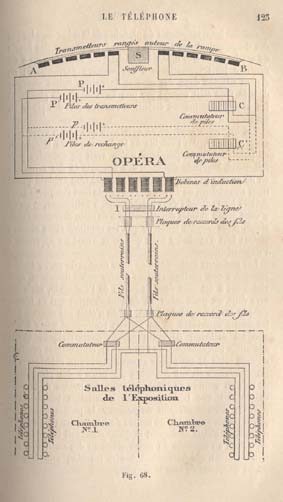
Théâtrophone
The sequence begins with the Théâtrophone.
1933
Auditory Perspective
Bell Telephone Laboratories’ three-channel relay of the Philadelphia Orchestra to Washington; covered on the Era 02 page once its source is linked.
1958
Philips Pavilion
Le Corbusier and Xenakis’s pavilion for Expo 58; text pending its source link.
1967
Azimuth Co-ordinator
Pink Floyd’s joystick-panned four-channel layout at Games for May, told on the Era 04 page.
Sources, summarised in our own words
- Azimuth Co-ordinator (collection record O76817) · Victoria and Albert Museum
1970
Expo ’70, Osaka
The West German pavilion held a spherical auditorium whose sound and lighting were designed at TU Berlin. Stockhausen’s music was performed there live every day of the fair.
Sources, summarised in our own words
- Osaka Expo ’70: The promise and reality of a spherical sound stage (Sean Williams) · inSonic 2015 · link pending
Late 1970s
Delta Stereophony
East German localisation system; text pending its source link.
1988
Wave field synthesis
A. J. Berkhout published the theory in the Journal of the AES, told on the Era 05 page.
Sources, summarised in our own words
- Wave field synthesis · Wikipedia
2004
IOSONO
Fraunhofer’s IOSONO system built on wave field synthesis.
2008
First live WFS transmission
An organ recital in Cologne Cathedral was recreated live in a TU Berlin lecture hall over 2,700 loudspeakers on 832 channels.
Sources, summarised in our own words
- Wave field synthesis · Wikipedia
2016–2021
Object-based reinforcement
The thread arrives at L-ISA, Soundscape, Spacemap Go and HOLOPLOT.