Cutting the cable
Wireless microphones and spectrum
Wireless freed performers from the cable in the 1950s and has been fighting for spectrum ever since.
1953
Shure Vagabond 88
Shure showed the Vagabond 88 at the 1953 Electronic Parts Show in Chicago: a handheld valve transmitter on the 2 MHz band, received through a wire loop run around the stage, good for up to 12 hours on two batteries. At $700 it sold poorly and was discontinued around 1960. Shure notes earlier wireless uses at a 1947 British ice show and a 1951 baseball game.
Sources, summarised in our own words
- The Vagabond 88 Microphone: Wireless Wizardry Before Its Time · Shure · link pending
1957–1958
Sennheiser
Sennheiser’s first wireless microphone of 1957 needed a valve and several batteries; the transistor SK 1002 pocket transmitter replaced it in 1958. With Telefunken, Sennheiser sold wireless systems under the Mikroport name.
Sources, summarised in our own words
- Sennheiser Celebrates 50 Years of Wireless Microphones · Mix · link pending
1959–1976
Onto the stage
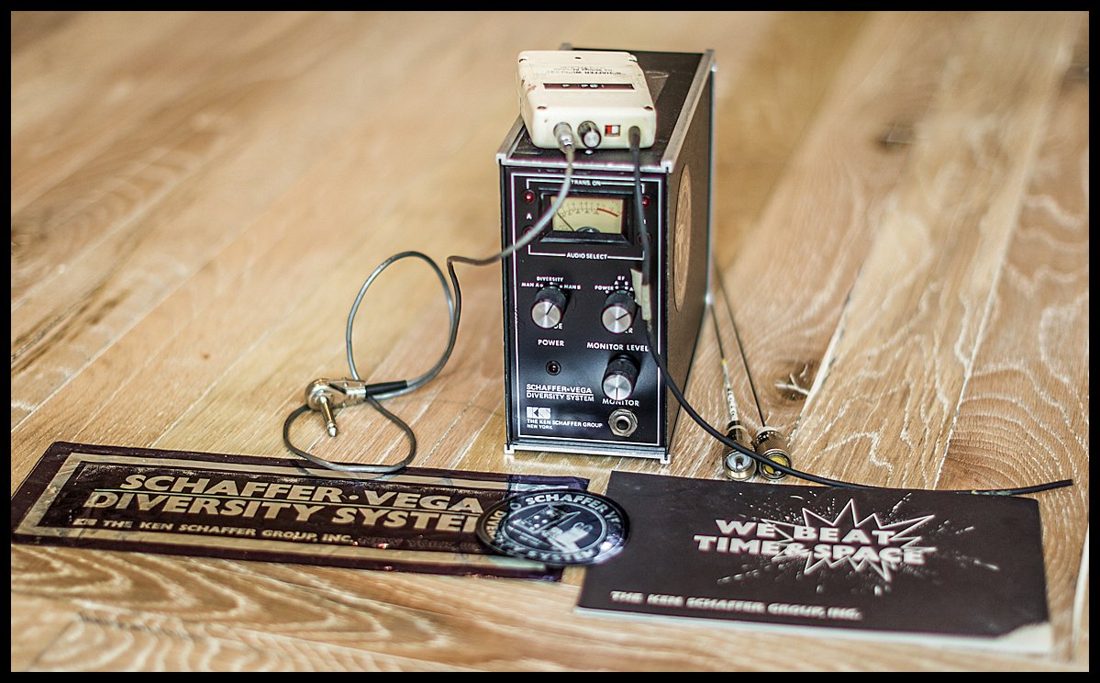
The thread continues through the Vega Cordless Mike (1959), the body microphones of Funny Girl (1964, on the Theatre page) and the Schaffer-Vega Diversity System (1976).
2010–2020
Losing spectrum
In the United States, the FCC barred wireless microphones from the 700 MHz band (698–806 MHz) in 2010. The 600 MHz incentive auction ended on 13 April 2017, and wireless microphones had to leave 617–652 and 663–698 MHz by 13 July 2020. In the UK, Ofcom auctioned 790–862 MHz in 2013, and Channel 38 (606–614 MHz) replaced Channel 69 for radio microphones. Each move forced touring and theatre productions to re-buy or re-band their systems.
Sources, summarised in our own words
- Wireless Microphones · FCC · link pending
- Wireless microphone licensing · Wikipedia