Equipment file · Valve power amplifier design

Williamson amplifier

D. T. N. Williamson · 1947

Evidence status · documented

Identity and core specifications are documented; some historical fields remain unavailable.

D. T. N. Williamson published 'Design for a High-Quality Amplifier' in Wireless World in April and May 1947: a four-stage push-pull amplifier with triode-connected KT66 outputs, deep negative feedback and a wide-band output transformer, giving about 15 watts at very low distortion. It was reprinted as a booklet and copied widely through the 1950s.

Introduced
1947
Category
Valve power amplifier design
Intended use
High-fidelity reproduction, widely adapted for amplified sound
Production
Published design by D. T. N. Williamson in Wireless World; built by hobbyists and manufacturers

Equipment photographs · 1
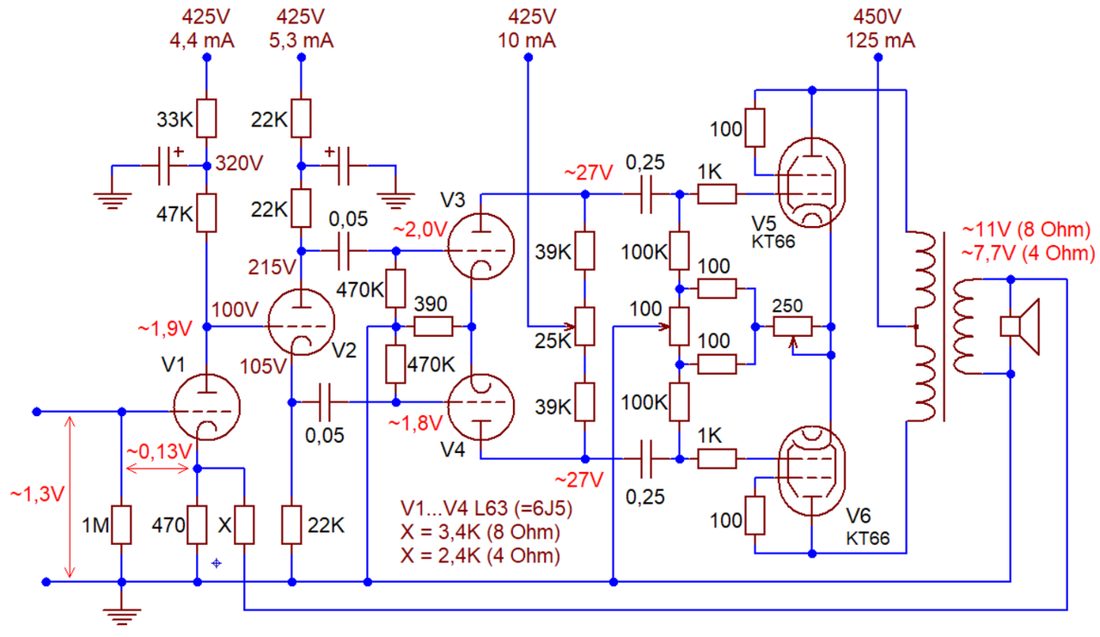
The original Williamson amplifier schematic (1947)

1 / 1 · The original Williamson amplifier schematic (1947)

The original Williamson amplifier schematic (1947)·Retired electrician·Public domain

Why it mattered

  1. 01

    It set the reference standard for amplifier fidelity in the 1950s.

  2. 02

    Because it was published for home construction, it influenced commercial amplifiers on both sides of the Atlantic, alongside the [[leak-point-one|Leak Point One]].

Engineering record

Topology
Four-stage push-pull design with triode-connected KT66 outputs and deep negative feedback[1]
Output power
About 15 watts[1]

Original pricing

No reliable period price located

2026 equivalent

Not calculated without a reliable original price.

Public price evidence was not sufficient to publish a defensible original figure.

Use in the field

No named deployment could be tied to this exact item by a checked source yet. Know of one? Suggest it on the contribute page.

Manuals & original documents

Sources

  1. 1The Williamson Amplifier: Details of Chosen Circuit and Its PerformanceWireless World (reprint via r-type.org) · technical paper · 1947-05

Contribute to the record

Know more about Williamson amplifier?

Corrections, firsthand information, original documents, and credited photograph sources are welcome.

Your email is private and will not appear in the archive. Contributions are not published automatically.

Help build the archive

A missing piece? A correction?

Contribute to Resonant

Support the archive

Resonant is built one verified record at a time: research hours, archival image rights, and the hosting that keeps every era, equipment file, and citation free to read. If this archive is useful to you, a donation of any size keeps the next entry moving.

How donations are used

Payments go directly to the archive’s editor through Venmo and Cash App. Resonant is an independent project rather than a registered charity, so donations are not tax-deductible and nothing is sold or subscribed to in return.