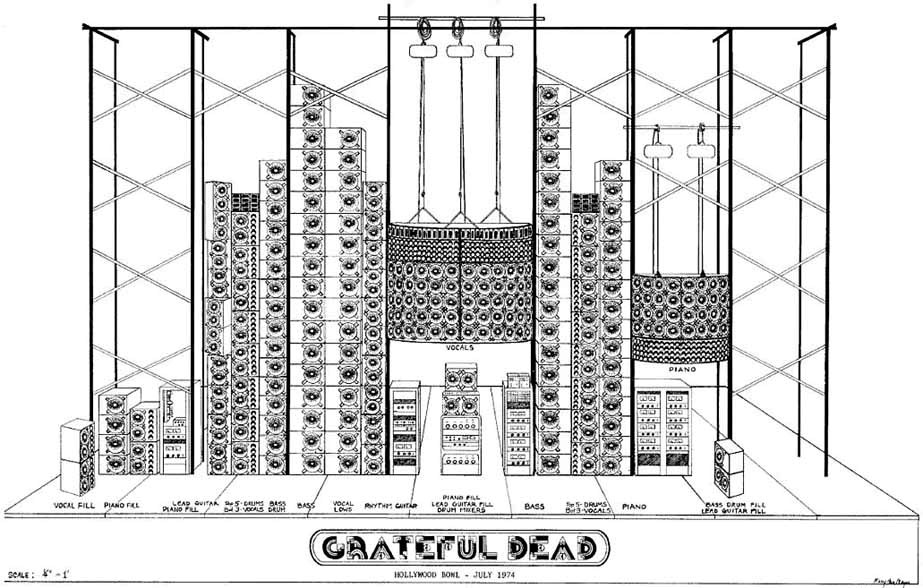
Ron Wickersham's elevation drawing identifies the stage and source-specific loudspeaker sections.
Wall of Sound elevation drawing, 1974·Ron Wickersham·CC BY-SA 4.0Why it mattered
- 01
Assigned instruments and vocals to separate arrays and used the entire system as stage monitoring.
- 02
Pursued low distortion, source localization, and enormous headroom as one integrated experimental system.
Original pricing
No reliable total build cost located
2026 equivalent
Not calculated without a reliable original price.
Conflicting figures circulate without a sufficiently complete primary accounting.
Use in the field
The complete structure debuted at the Cow Palace in 1974 and was retired from regular use after October because its transport and operating demands were unsustainable.[1]
Professional reactions
Later recollection · Interview originally mid-1990s; republished 15 May 2011
Healy recalled the Dead’s crew wanting to go beyond the basic public-address rigs then available. They used the Wall of Sound to investigate distortion, distribution and dispersion because reliable information about large stacked arrays was scarce.
Manuals & original documents
Contribute to the record
Know more about Wall of Sound?
Corrections, firsthand information, original documents, and credited photograph sources are welcome.