Equipment file · Cardioid dynamic microphone

565 Unisphere

Shure · 1960s

Evidence status · documented

Identity and core specifications are documented; some historical fields remain unavailable.

The Shure 565 Unisphere I is a dual-impedance cardioid dynamic microphone with a spherical wire-mesh grille containing a wind and pop filter, intended for theatre stage systems, recording and large PA such as conventions and stadiums. It is nicknamed the 'Woodstock microphone'.

Introduced
1960s
Category
Cardioid dynamic microphone
Intended use
Theatre stage, recording and large PA
Production
Shure, as the Unisphere I; the 565SD derivative remains in production

Equipment photographs · 1
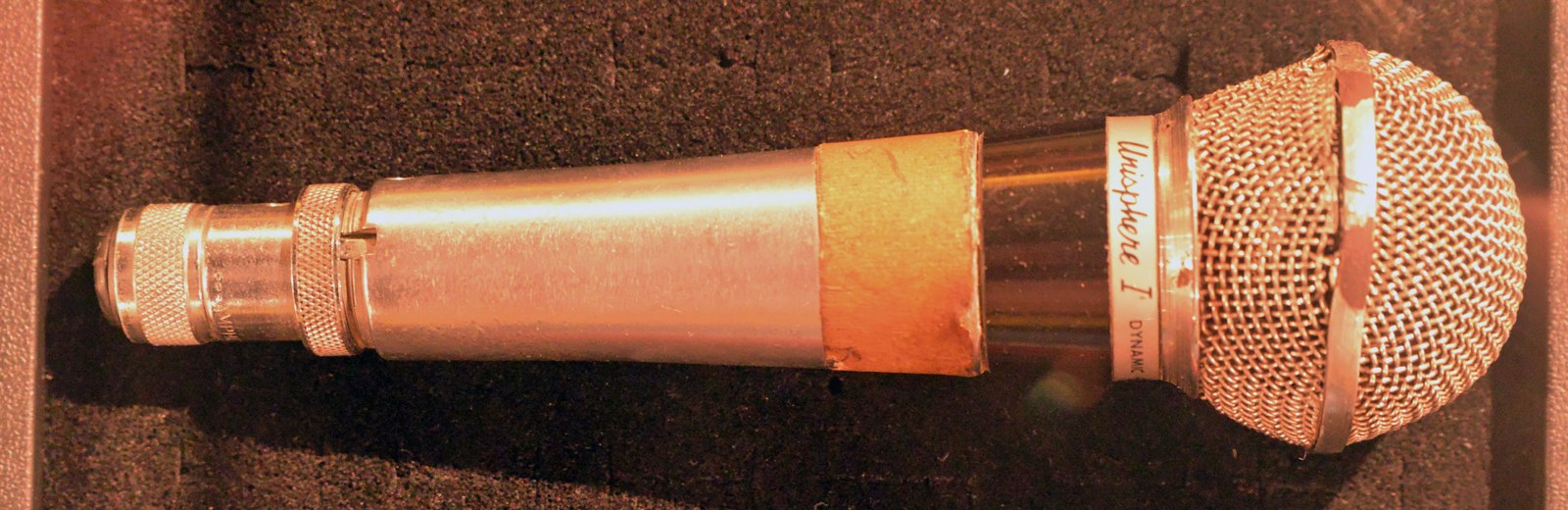
Shure Unisphere 565 displayed at the Woodstock site museum

1 / 1 · Shure Unisphere 565 displayed at the Woodstock site museum

Shure Unisphere 565 displayed at the Woodstock site museum·Jud McCranie·CC BY-SA 4.0

Why it mattered

  1. 01

    Its spherical grille and built-in filter improved close-miked live use.

  2. 02

    It popularised the ball-grille form continued by the SM58.

Engineering record

Pattern
Cardioid, uniform with frequency[1]
Frequency response
50 Hz to 15,000 Hz[1]
Grille
Spherical wire mesh with built-in wind and pop filter[1]

Original pricing

$95.00 (1967)

2026 equivalent

≈ $950

Period US list or retail price reported by the cited source.[2]

Estimated in 2026 US dollars using the BLS CPI-U annual average for 1967 (33.4) and 334.980 for 2026, rounded to the nearest $10.[3]

Use in the field

Used on stage at the 1969 Woodstock festival[2]

Manuals & original documents

Sources

  1. 1Model 565 Unisphere IShure · manual
  2. 2Unisphere I 565Radiomuseum.org · reference · 1967
  3. 3CPI Inflation Calculator methodology and CPI-U dataU.S. Bureau of Labor Statistics · reference · 2026

Contribute to the record

Know more about 565 Unisphere?

Corrections, firsthand information, original documents, and credited photograph sources are welcome.

Your email is private and will not appear in the archive. Contributions are not published automatically.

Help build the archive

A missing piece? A correction?

Contribute to Resonant

Support the archive

Resonant is built one verified record at a time: research hours, archival image rights, and the hosting that keeps every era, equipment file, and citation free to read. If this archive is useful to you, a donation of any size keeps the next entry moving.

How donations are used

Payments go directly to the archive’s editor through Venmo and Cash App. Resonant is an independent project rather than a registered charity, so donations are not tax-deductible and nothing is sold or subscribed to in return.