Equipment file · Continuous-wave radio transmitter

Poulsen arc converter

Valdemar Poulsen · 1902–1903

Evidence status · documented

Identity and core specifications are documented; some historical fields remain unavailable.

Valdemar Poulsen's arc converter burned an electric arc in hydrogen to generate continuous radio-frequency current, making voice transmission by radio possible before valve transmitters. Cyril Elwell's Federal Telegraph Company developed it commercially in the US from 1909.

Introduced
1902–1903
Category
Continuous-wave radio transmitter
Intended use
Generating undamped radio waves for telegraphy and early radiotelephony
Production
Developed by Valdemar Poulsen and P. O. Pedersen; built under licence by Federal Telegraph and others

Equipment photographs · 1
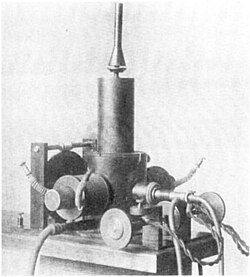
Poulsen's first arc converter

1 / 1 · Poulsen's first arc converter

Poulsen's first arc converter·Valdemar Poulsen·Public domain

Why it mattered

  1. 01

    Continuous waves allowed voice to be modulated onto radio, an early step toward broadcasting speech to large audiences.

  2. 02

    It was replaced by valve transmitters in the 1920s, the same valves that powered public address.

Engineering record

Operating principle
An arc in hydrogen converted direct current into continuous radio-frequency oscillation[1]

Original pricing

No reliable period price located

2026 equivalent

Not calculated without a reliable original price.

Public price evidence was not sufficient to publish a defensible original figure.

Use in the field

Developed commercially in the US from 1909 by Cyril Elwell's Federal Telegraph Company[1]

Manuals & original documents

No authoritative manual or original document has been located for this profile.

Sources

  1. 1The Arc vs the SparkSociety of Wireless Pioneers · archive

Contribute to the record

Know more about Poulsen arc converter?

Corrections, firsthand information, original documents, and credited photograph sources are welcome.

Your email is private and will not appear in the archive. Contributions are not published automatically.

Help build the archive

A missing piece? A correction?

Contribute to Resonant

Support the archive

Resonant is built one verified record at a time: research hours, archival image rights, and the hosting that keeps every era, equipment file, and citation free to read. If this archive is useful to you, a donation of any size keeps the next entry moving.

How donations are used

Payments go directly to the archive’s editor through Venmo and Cash App. Resonant is an independent project rather than a registered charity, so donations are not tax-deductible and nothing is sold or subscribed to in return.