Equipment file · Electrodynamic transducer

Moving-coil receiver

Experimental · 1898 patent

Evidence status · verified

Claims in this file are tied to item-specific sources.

A current-carrying coil in a magnetic field moves a diaphragm.

Introduced
1898 patent
Category
Electrodynamic transducer
Intended use
Electrical reproduction of speech and sound
Production
Experimental before commercial loudspeakers of the 1920s

Equipment photographs · 1
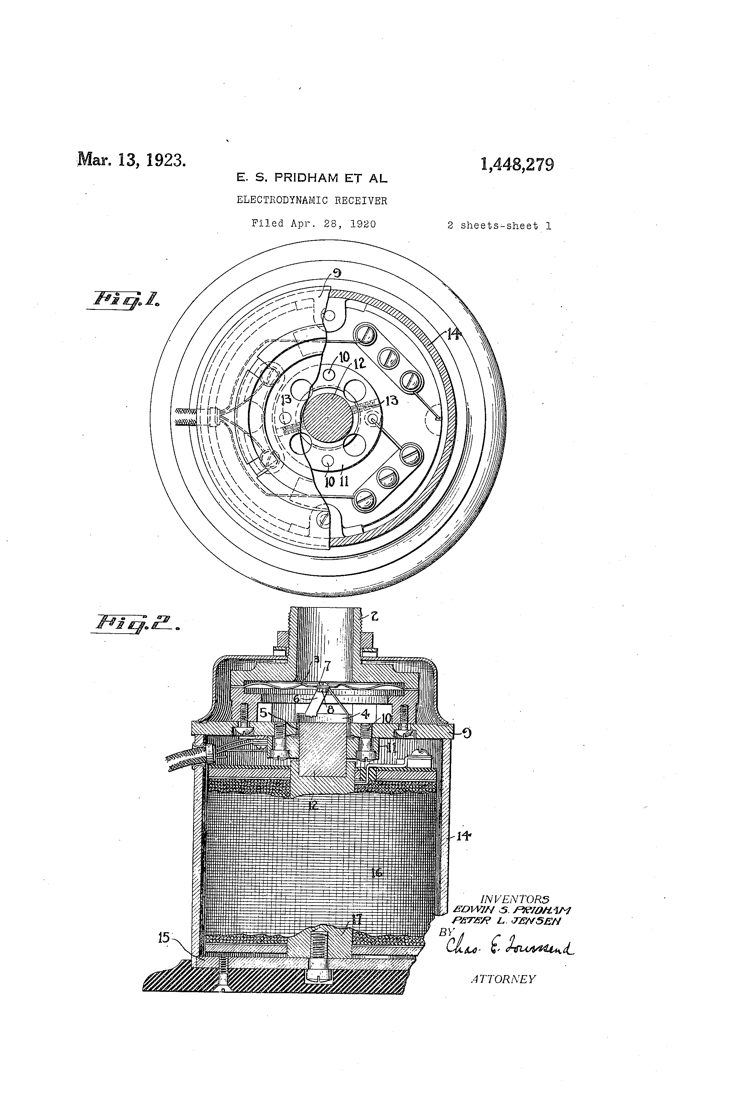
US patent 1,448,279 (1923): electrodynamic receiver

1 / 1 · US patent 1,448,279 (1923): electrodynamic receiver

US patent 1,448,279 (1923): electrodynamic receiver·Edwin S. Pridham & Peter L. Jensen·Public domain (US patent)

Why it mattered

  1. 01

    Established the motor geometry—current-carrying coil in a magnetic field—that became foundational to practical dynamic loudspeakers.

  2. 02

    Paired with horn loading, the principle could convert limited amplifier power into useful acoustic output.

Engineering record

Motor
Audio current through a coil produces force in a magnetic gap and moves an attached diaphragm.[1]
Limitation
Early versions lacked the powerful magnets, lightweight diaphragms, and amplification needed for broad-band public reinforcement.[2]

Original pricing

No reliable period price located

2026 equivalent

Not calculated without a reliable original price.

The archive entry describes an experimental principle, not a single retail product.

Use in the field

The principle predates professional touring; its relevance is as the electromechanical basis of the moving-coil cone and compression drivers that followed.[2]

Professional reactions

Later recollection · 1975 (written c. 1942-44)

Jensen recalled that connecting their experimental receiver to a telephone microphone produced unexpectedly strong, clear speech. He remembered being astonished by how well the moving-coil instrument worked.

Peter L. Jensen, Co-inventor (with Edwin Pridham) of the moving-coil telephone receiver; later founder, Magnavox1911 experimental receiver described decades later by one of its inventors; not an endorsement of Lodge’s 1898 patent. · Independent firsthand source · Paraphrased account[3]The Havilah Press (self-published family edition, hosted by Southern California/California Historical Radio Society) · The Great Voice

Manuals & original documents

Sources

  1. 1Improvements in Syntonic TelegraphyEuropean Patent Office · patent · 1898
  2. 2Loudspeaker HistoryAudio Engineering Society · reference
  3. 3The Great VoiceThe Havilah Press (self-published family edition, hosted by Southern California/California Historical Radio Society) · interview · 1975 (written c. 1942-44)

Contribute to the record

Know more about Moving-coil receiver?

Corrections, firsthand information, original documents, and credited photograph sources are welcome.

Your email is private and will not appear in the archive. Contributions are not published automatically.

Help build the archive

A missing piece? A correction?

Contribute to Resonant

Support the archive

Resonant is built one verified record at a time: research hours, archival image rights, and the hosting that keeps every era, equipment file, and citation free to read. If this archive is useful to you, a donation of any size keeps the next entry moving.

How donations are used

Payments go directly to the archive’s editor through Venmo and Cash App. Resonant is an independent project rather than a registered charity, so donations are not tax-deductible and nothing is sold or subscribed to in return.