Equipment file · Loud-speaking intercom with sensitive carbon microphone

Dictograph acoustic system

Turner / Kelley · 1907

Evidence status · documented

Identity and core specifications are documented; some historical fields remain unavailable.

Kelley Monroe Turner built the Dictograph around the Metrophone, a sensitive carbon microphone patented with Norton Johnson in 1907, whose oversized diaphragm picked up conversation at a distance. Later Dictograph lines included the Master Call loud-speaking announcing system and the Acousticon hearing aid.

Introduced
1907
Category
Loud-speaking intercom with sensitive carbon microphone
Intended use
Hands-free office intercom, announcing and covert listening
Production
General Acoustic Company / Dictograph Products, Jamaica, New York

Equipment photographs · 1
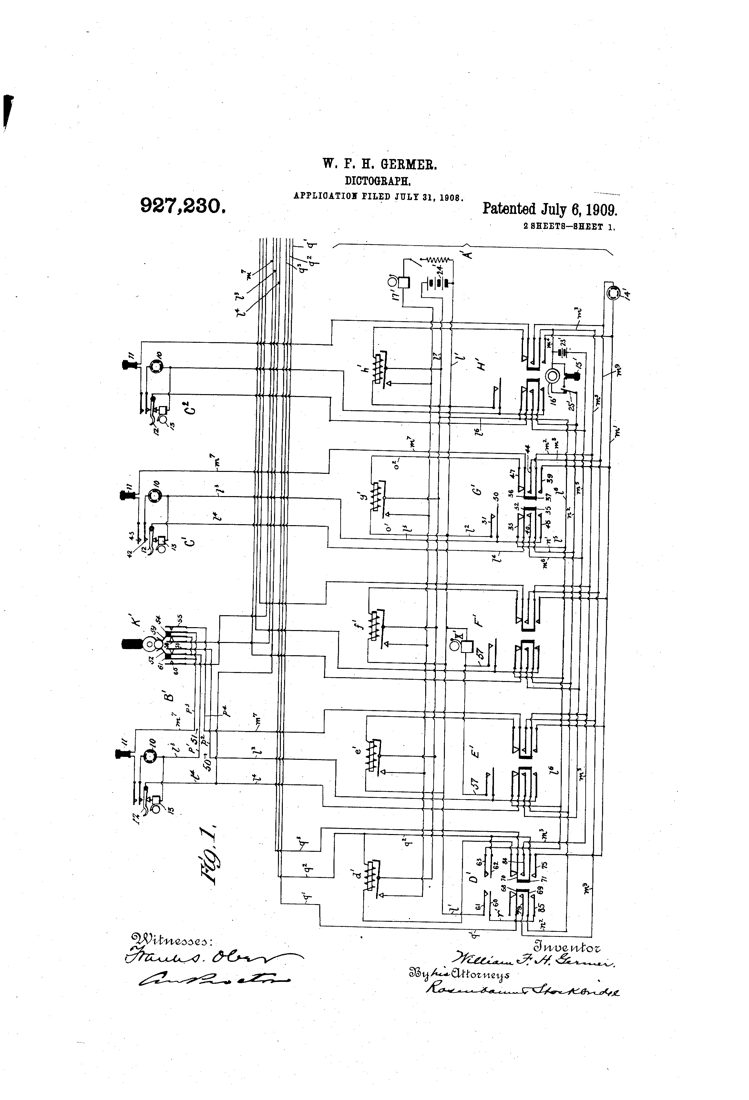
US patent 927,230 (1909): Dictograph

1 / 1 · US patent 927,230 (1909): Dictograph

US patent 927,230 (1909): Dictograph·William F. H. Germer·Public domain (US patent)

Why it mattered

  1. 01

    It showed hands-free, loud-speaking voice pickup and distribution before valve public-address amplifiers existed.

  2. 02

    It became one of the earliest documented covert listening devices.

Engineering record

Product line
Interior telephones alongside the Master Call loud-speaking announcing system, Acousticon hearing aid and Aviaphone intercom[1]

Original pricing

No reliable period price located

2026 equivalent

Not calculated without a reliable original price.

Public price evidence was not sufficient to publish a defensible original figure.

Use in the field

No named deployment could be tied to this exact item by a checked source yet. Know of one? Suggest it on the contribute page.

Manuals & original documents

Sources

  1. 1Dictograph Products Corporation interior telephones catalogueDictograph Products Corporation (via Telephone Archive) · brochure · 1919
  2. 2History of the Dictograph CompanyBritishTelephones.com · reference

Contribute to the record

Know more about Dictograph acoustic system?

Corrections, firsthand information, original documents, and credited photograph sources are welcome.

Your email is private and will not appear in the archive. Contributions are not published automatically.

Help build the archive

A missing piece? A correction?

Contribute to Resonant

Support the archive

Resonant is built one verified record at a time: research hours, archival image rights, and the hosting that keeps every era, equipment file, and citation free to read. If this archive is useful to you, a donation of any size keeps the next entry moving.

How donations are used

Payments go directly to the archive’s editor through Venmo and Cash App. Resonant is an independent project rather than a registered charity, so donations are not tax-deductible and nothing is sold or subscribed to in return.