Equipment file · Microphone transducer

Carbon transmitter

Multiple inventors · 1877

Evidence status · verified

Claims in this file are tied to item-specific sources.

Sound pressure varies electrical resistance through compressed carbon granules.

Introduced
1877
Category
Microphone transducer
Intended use
Telephone speech and early voice transmission
Production
Late 1870s–1980s in evolving forms

Equipment photographs · 2
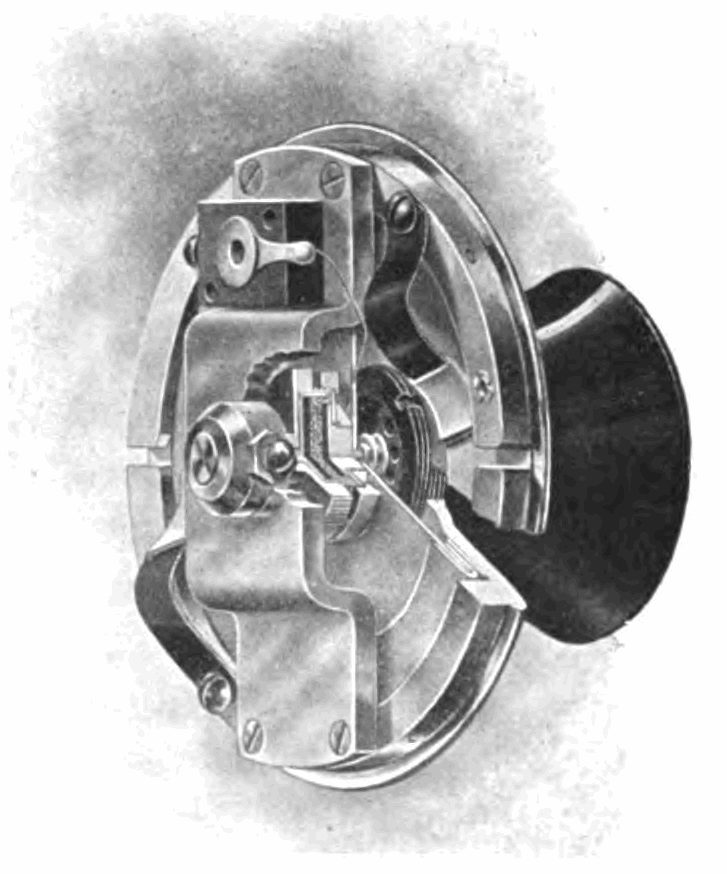
Cutaway drawing of a carbon-button transmitter (Van Deventer, 1910s)

1 / 2 · Cutaway drawing of a carbon-button transmitter (Van Deventer, 1910s)

Cutaway drawing of a carbon-button transmitter (Van Deventer, 1910s)·H. R. Van Deventer·Public domain

Why it mattered

  1. 01

    Converted speech into a comparatively strong electrical signal without an external preamplifier.

  2. 02

    Made long-distance voice transmission practical enough to establish the microphone side of the future PA signal chain.

Engineering record

Operating principle
A diaphragm compresses carbon granules, changing their electrical resistance in step with sound pressure.[2]
Trade-off
High output and simplicity came with restricted bandwidth, granular noise, and distortion unsuitable for later high-fidelity reinforcement.[3]

Original pricing

No reliable period price located

2026 equivalent

Not calculated without a reliable original price.

The transmitter emerged through several competing patents and commercial telephone instruments rather than one documented retail launch.

Use in the field

Its immediate domain was telephony rather than concerts, but it supplied the sensitive electrical pickup that early public-address experiments required.[1]

Professional reactions

Later recollection · 16 April 1973 (interview date; events recalled from c.1918)

Maxfield recalled that his early Western Electric assignment was carbon-microphone research. He regarded that work as limited in progress before his First World War service interrupted it.

Joseph P. Maxfield, Bell Telephone Laboratories engineer (recording and acoustical engineering)Retrospective account of carbon-microphone research, not a reaction to a particular Edison or Berliner model. · Independent firsthand source · Paraphrased account[4]IEEE History Center / Engineering and Technology History Wiki (ETHW) · Oral-History: Joseph Maxfield (interview by Frank A. Polkinghorn)

Manuals & original documents

Sources

  1. 1The Invention of the TelephoneLibrary of Congress · archive
  2. 2Microphone: carbon microphoneEncyclopaedia Britannica · reference
  3. 3Carbon microphoneEngineering and Technology History Wiki · reference
  4. 4Oral-History: Joseph Maxfield (interview by Frank A. Polkinghorn)IEEE History Center / Engineering and Technology History Wiki (ETHW) · interview · 16 April 1973 (interview date; events recalled from c.1918)

Contribute to the record

Know more about Carbon transmitter?

Corrections, firsthand information, original documents, and credited photograph sources are welcome.

Your email is private and will not appear in the archive. Contributions are not published automatically.

Help build the archive

A missing piece? A correction?

Contribute to Resonant

Support the archive

Resonant is built one verified record at a time: research hours, archival image rights, and the hosting that keeps every era, equipment file, and citation free to read. If this archive is useful to you, a donation of any size keeps the next entry moving.

How donations are used

Payments go directly to the archive’s editor through Venmo and Cash App. Resonant is an independent project rather than a registered charity, so donations are not tax-deductible and nothing is sold or subscribed to in return.