Equipment file · Triode vacuum-tube gain stage

Audion amplifier

De Forest / later developers · 1906 patent; amplification demonstrated later

Evidence status · verified

Claims in this file are tied to item-specific sources.

A control grid modulates plate current, allowing a small signal to control a larger one.

Introduced
1906 patent; amplification demonstrated later
Category
Triode vacuum-tube gain stage
Intended use
Detection, oscillation, and electrical signal amplification
Production
1907 onward in successive forms

Equipment photographs · 1
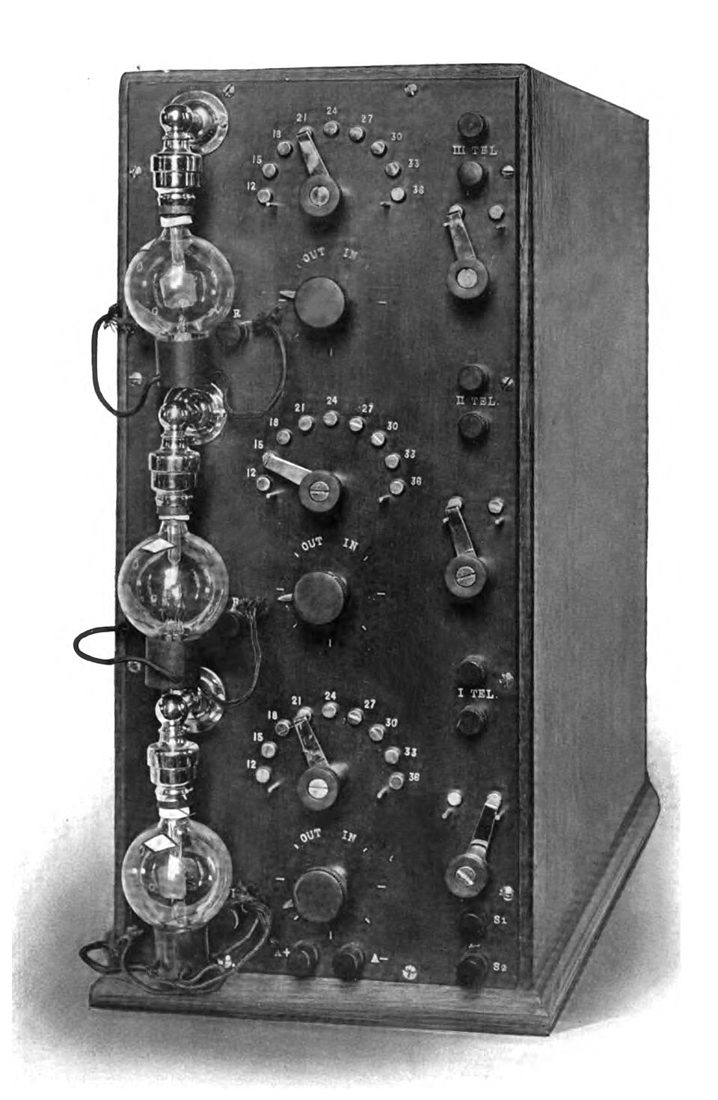
First Audion amplifier 1914

1 / 1 · First Audion amplifier 1914

First Audion amplifier 1914·Lee De Forest·Public domain

Why it mattered

  1. 01

    Added an active gain element between microphone and loudspeaker.

  2. 02

    Made cascaded electrical amplification possible, completing the conceptual architecture of a modern sound-reinforcement chain.

Engineering record

Control element
A grid placed between filament and plate controls a larger plate current with a smaller input signal.[1][2]
Historical caution
De Forest patented the three-electrode device, while later researchers established and refined its practical amplifier circuits.[2]

Original pricing

No reliable launch price located

2026 equivalent

Not calculated without a reliable original price.

Surviving records describe patents and licenses more consistently than a single public list price.

Use in the field

The Audion itself was not concert equipment; its importance is enabling the tube amplifiers used by the first complete public-address systems.[2]

Manuals & original documents

Sources

  1. 1Space TelegraphyUnited States Patent Office · patent · 1908
  2. 2Lee de ForestEngineering and Technology History Wiki · reference

Contribute to the record

Know more about Audion amplifier?

Corrections, firsthand information, original documents, and credited photograph sources are welcome.

Your email is private and will not appear in the archive. Contributions are not published automatically.

Help build the archive

A missing piece? A correction?

Contribute to Resonant

Support the archive

Resonant is built one verified record at a time: research hours, archival image rights, and the hosting that keeps every era, equipment file, and citation free to read. If this archive is useful to you, a donation of any size keeps the next entry moving.

How donations are used

Payments go directly to the archive’s editor through Venmo and Cash App. Resonant is an independent project rather than a registered charity, so donations are not tax-deductible and nothing is sold or subscribed to in return.